VO Tech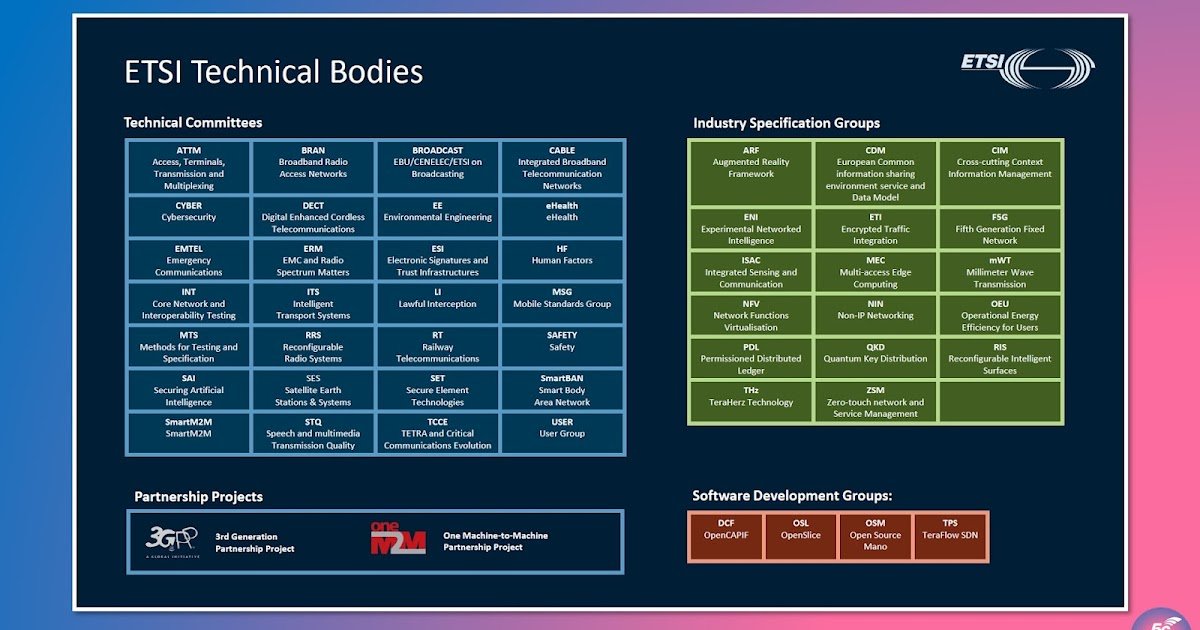
The European Telecommunications Standards Institute (ETSI) is a leading standards development organisation (SDO) recognised for producing globally applicable standards for ICT, including fixed, mobile, radio, converged, broadcast, and internet technologies. Based in Europe but with worldwide influence, ETSI provides an open and inclusive environment for industry players to collaborate on the development of future technologies.
A recent overview presentation of ETSI by Jan Ellsberger, ETSI’s Director General, is available on the 3GPP website here.

ETSI’s Industry Specification Groups (ISGs) are collaborative groups formed within ETSI to address emerging and often pre-standardisation topics in a flexible, fast, and open manner. They provide a platform for industry players, including companies, research organisations, and other stakeholders, to work together on technical specifications outside the constraints of formal standardisation processes.
Key Features of ISGs include:
- Focus on innovation: ISGs often tackle new or rapidly evolving technologies, such as Network Functions Virtualisation (NFV), Quantum Key Distribution (QKD), and AI.
- Open participation: Participation is open to ETSI members and non-members, although non-members pay a fee.
- Faster timelines: ISGs are designed to deliver results quickly, often within 12–24 months, making them well-suited for fast-moving domains.
- Flexible structure: They are less formal than ETSI Technical Committees, which allows more agile collaboration.

ISGs produce documents such as:
- Group Specifications (GS) – technical specifications that can later be taken up by formal standardisation bodies.
- Group Reports (GR) – informative reports including use cases, frameworks, or recommendations.
ISGs help shape the direction of future standards and industry practices by offering an open, collaborative environment for technical consensus. They often bridge the gap between research and standardisation.
Dr Howard Benn, a mobile industry veteran with contributions spanning from GSM to 5G, has created a short video on ETSI’s ISGs, embedded below:
Related Posts:
#Understanding #ETSIs #Industry #Specification #Groups #ISGs #Matter